Recipe & Food Cost Management
Recipe & food cost software to price every dish right.
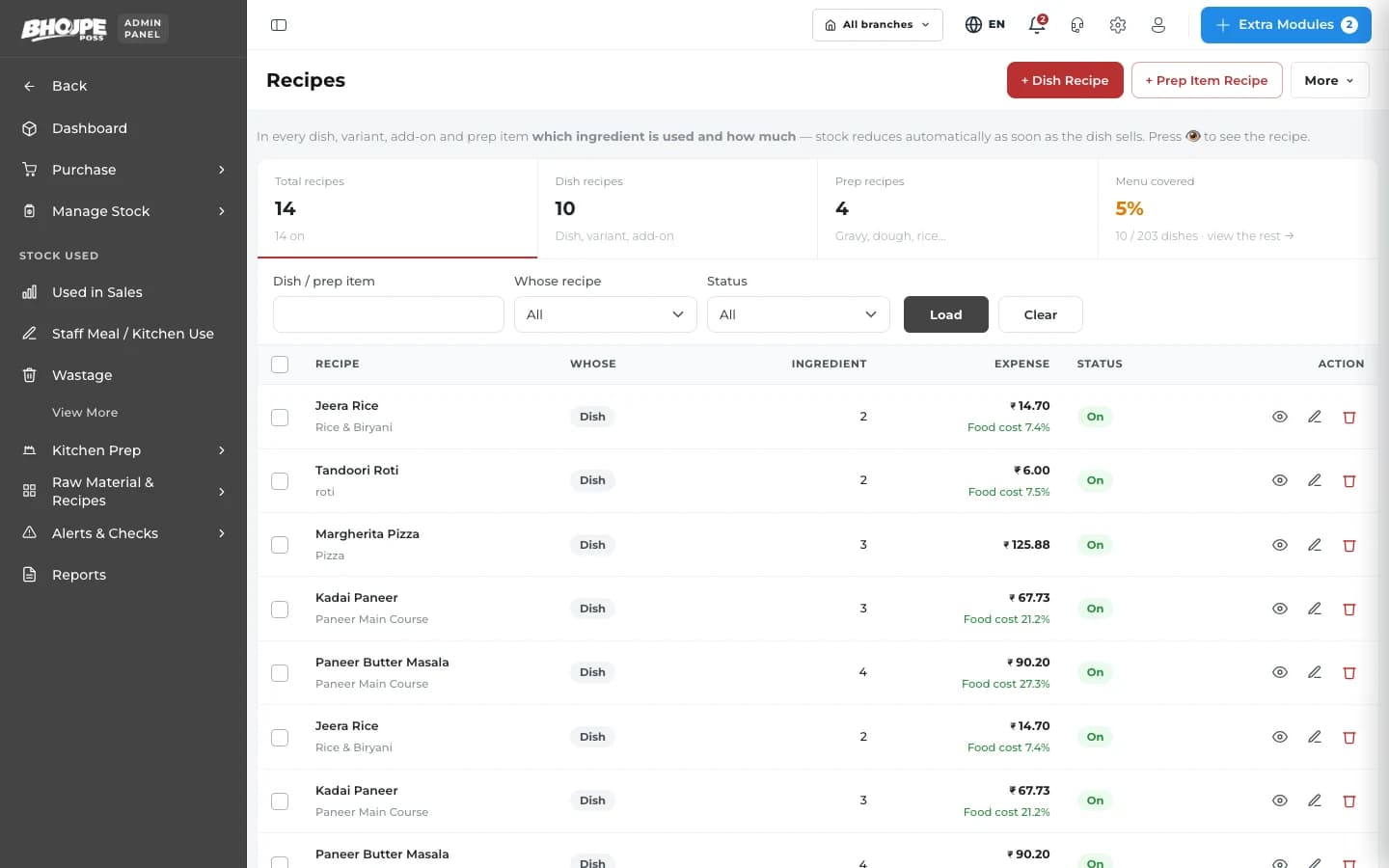
Define recipes once and Bhojpe calculates what each dish costs to make, its food cost percentage and how much stock it uses.
- Recipe builder
- Cost per plate
- Food cost %
Recipe & Food Cost
From ingredients to margins
Recipe builder
List ingredients and quantities for every dish and variant.
Cost per plate
Automatic cost based on your purchase prices.
Food cost %
See food cost percentage against selling price.
Sub-recipes
Use gravies, batters and bases as ingredients in other dishes.
Stock deduction
Recipes drive automatic inventory deduction.
Dish margins
Compare what a dish costs with what it sells for, so low-margin items stand out.
Costing
See what each dish really costs.
When ingredient prices change, your dish costs update too — so you know when it's time to revise prices.
- Ingredient-level costing
- Selling price vs cost
- Food cost percentage
Consistency
The same dish, the same way, every time.
Standard recipes help every chef use the same quantities, which keeps taste and cost consistent across shifts and outlets.
- Standard quantities
- Consistent across outlets
- Less over-portioning
Why food cost is worked out per plate
Overall food cost tells you there may be a problem. Cost per plate tells you where. Bhojpe builds this from the recipe: list the ingredients and quantities for a dish, including its variants and add-ons, and the cost comes from what you actually paid for those ingredients.
Dividing that cost by the selling price gives the food cost percentage. A dish that costs ₹80 to make and sells for ₹280 has a food cost of 28.6%. Prep items such as gravies and batters can be used as ingredients in other recipes, so a change in the base gravy carries through to every dish made with it. Our guide to calculating food cost percentage walks through the formula.
Written recipes also protect consistency. When every shift uses the same quantities, the dish tastes the same and the cost stays predictable. The recipes then drive automatic stock deduction, so costing and inventory stay in step.
- Recipes for each dish, variant and add-on
- Prep items used inside other recipes
- Cost and food cost % against selling price