Food cost percentage tells you how much of each rupee of food sales goes on the ingredients. If your food cost is 30%, then ₹30 of every ₹100 sold went on raw material. It is one of the few numbers that shows quickly whether a kitchen is under control.
The food cost formula for one dish
Food cost % = (cost of ingredients in the dish ÷ selling price) × 100
Take a plate of paneer tikka selling at ₹280:
- Paneer, 150 g: ₹54
- Curd and spices, 60 g: ₹12
- Capsicum and onion, 80 g: ₹8
- Oil and butter, 20 g: ₹6
The ingredients cost ₹80 in total. ₹80 ÷ ₹280 × 100 gives a food cost of 28.6%. These figures are only an example, so use the prices you actually pay.
The formula for the whole restaurant
Dish-level numbers show what should happen. The period-level calculation shows what did happen.
Food cost % = ((opening stock + purchases − closing stock) ÷ food sales) × 100
Say you started the month with ₹50,000 of stock, bought ₹3,00,000 more and ended with ₹60,000. You used ₹2,90,000 of ingredients. If food sales were ₹9,00,000, your food cost was 32.2%.
What is a good food cost percentage?
There is no single right figure. Many restaurant operators aim for somewhere around 28% to 35%, but the sensible number depends on your format. A dosa counter and a seafood restaurant will never look alike. Your own trend is more useful than an industry average: if the number rises by three points in a month and your menu has not changed, something has gone wrong.
Why the two numbers never match
The dish calculation gives you your ideal cost, and the monthly calculation gives you your actual cost. The difference between them is money lost to wastage, over-portioning, theft, wrong entries or dishes given away without a record. Most of the useful work in cost control happens in that gap.
How to bring food cost down
- Write down recipes with exact quantities, so every shift uses the same amount
- Count stock on a fixed schedule and compare it with what your sales say should be left
- Log wastage when it happens rather than at the end of the week. Our guide on reducing food wastage has more detail
- Recheck dish costs when a key ingredient rises in price, as it often does with paneer, oil or tomatoes
- Look at high-selling dishes first, since saving ₹5 on a best seller beats saving ₹20 on a dish that rarely sells
- Record complimentary and staff meals, so they stop looking like unexplained stock loss
Doing this without a spreadsheet
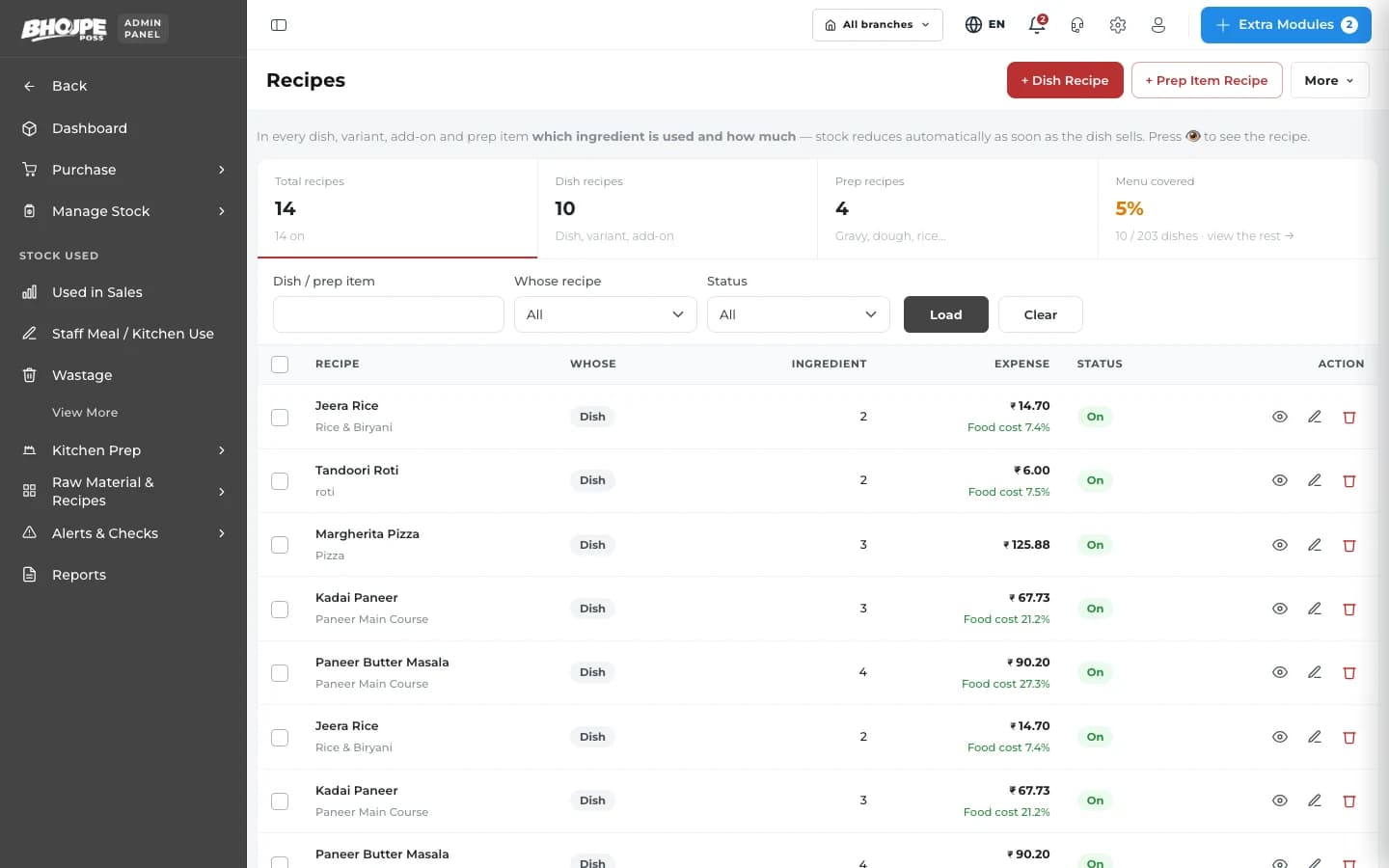
A spreadsheet works for ten dishes but struggles at a hundred, mainly because purchase prices change. In Bhojpe, recipe costing works out cost per plate from your purchase prices and the inventory module deducts stock as you sell, so you can compare expected and actual stock without building the sums yourself.